Showing posts with label Pinot Noir. Show all posts

Monday, June 29, 2015

I always get asked, "What's news" at Murdoch James?

Well, there is certainly some fantastic news to share today.

In an exciting development that reinforces Martinborough’s prominent position as New Zealand’s premier Pinot Noir producer, and our profile as a leader in the region, we recently announced that we are removing 10 hectares of Sauvignon Blanc vines and replacing them with Pinot Noir. In all, more than 25,000 vines will be replaced at a cost of over $300,000.
Chris Shaw cutting out the old SB vines

This is not a decision for the faint-hearted. Not only is there a significant cost involved; we also had to accept it can take up to 3-5 years for the new vines to return a full crop.

Does not mean we don't like Sauvignon Blanc; it just means we love Pinot Noir more. We will still be keeping around 20% of our Sauvignon Blanc vines, but the Pinot Noir plantings will nearly double.

Roger Fraser contemplating the change
The decision was made as we have not able to meet the export demand we have for Pinot. Every year we have to ration our customer orders. Against that background, using prime Pinot Noir vineyard land for Sauvignon Blanc did not make sense in either economic or strategic terms.

Easy to say that in the office, but when I went out into the vineyard today, it was a very emotional time. To see thousands of vines that have served us well being removed was heart-breaking.


What taking out 25,000 vines looks like
I just had to remind myself, this is the start of an exciting journey, where will capitalise on the strengths of our team and our terroir. 

Over the next three years we will tell the story of these vines, as they are planted and mature. So, watch this space for lots of updates.

Sunday, June 28, 2015

Bargain Pinot Noir?


Birth of a Wine Blogger has been in hibernation for a while, a bit like our dormant vines. 
Recently I was woken from my slumber by a colleague in the industry sending me a link to a Facebook post he had published. He was making the point that a certain Pinot Noir (see link) is on promotion in supermarkets for just $10 a bottle. He went on to say that it must be made from wine at the lower end of the spectrum, sourced from the countries featured on the label, to retail at that price.  He asked, in a world of commoditised, characterless wines, is this something we really need?

Check out: http://tinyurl.com/nesvbh2

What concerns me about this, as a dedicated Pinot producer, is that Kiwi consumers will buy this wine thinking it is a bargain, try it, may not have a great experience, think all Pinot Noir is the same, and be turned off the variety forever. 
Why did he conclude that the wine must come from the "lower end of the spectrum"? 
Let's dissect the $10 and see where he is coming from. Of the ten dollars, the government collects $3.66 (the ALAC levy of about 3 cents, plus $2.13 excise duty and $1.50 GST); pretty good return for the government! 
Then, assuming the retailer takes a 30% margin ($3) and the distributor a 20% margin ($2), that leaves $1.34 for the winemaking! Let's be conservative though and say the winery sells direct to the retailer, so no fee for the distributor. In that case the remaining sum is $3.34. Let's see where we end up if we consider that.
What's left to cover the wine component after allowing for bottling costs, freight and distribution, warehousing, marketing and other related expenses? Say these add up to $1.80 per bottle. That leaves $1.54 for the wine. Say my analysis is too tough. Add another $1 back to cover that. That leaves me to ponder the quality of wine you might buy at $2.54 per bottle? 
Contrast that with the cost per litre of our 2015 Pinot Noir. That was over $13 per litre, before bottling, taxes, etc. So even if my costs are high, we can safely assume it is not top quality, hand-picked Martinborough Pinot Noir in the wine we are discussing. 
Disclaimer: I have not yet tasted this wine. I will as soon as I can get a bottle though, then I'll report back. If I have wronged a good product I will admit that. However, my comments above are based on experience and general principles. I can say with confidence is that I have learned in my 30 years in the wine industry is that it would be an absolutely amazing achievement to deliver a 'Premium Pinot Noir' (which is what the label claims) for $10, let alone $2.54. 


Tuesday, September 11, 2012

Tough Vintage for 2012

I am currently travelling in Queensland, Australia, working with our major client's key stores; Vintage Cellars and First Choice. These are both top wine chains in the Australian market, with knowlegeable staff. The stores stock a great range of wines too. If you live in Australia, check them out sometime. Make sure you buy a bottle of Murdoch James Estate wine while you are there though!

Yesterday I was in a store in Brisbane and one of the team said " I would love to work on a vineyard and make wine, it must be great fun?".

I was prompted to say "Yes it is" but had to qualify the comment to "Yes it is, most of the time". The qualifier was because this year we had a very small vintage, due to cold, windy weather at flowering time, with the result that we had a much smaller fruit set than normal with some varieties. While our white harvest was top quality and good quantity, for some red varieties we had such small harvests that we will not be able to produce a wine from this vintage. An example is our 2012 Syrah. Such a small crop means it is not able to be bottled as a stand-alone wine. Does not sound so bad until you realise the implications; if there is no 2012 Blue Rock Syrah available, customers who enjoyed the 2011 and older vintages may change to something else before we release the 2013. Then we have to work with our retailers to rebuild the brand, and that equals time and money.

In other cases, like the Pinot Noir, the fruit was terrific quality, but the crop was down 40% per hectare. So we will make excellent wines from the Pinot Noir this year, but not a lot of it. We will just have sufficient wine to supply demand, so again sounds OK, until you dig deeper....

The cost per litre of wine is much higher in a small vintage than it is in a normal one. Think about it this way: we spend many hundreds of thousands of dollars each year in the vineyard to grow our grapes. And we have to spend that regardless of harvest size. We need to prune, mow, tuck, hand pick, trellis, etc with a full crop in mind. Now, if we are targeting (say) 200 tonnes of pinot a year, and we only get 100 tonnes, we have still spent the money - it is a sunk cost regardless of what size crop we get. So in this scenario (2012) effectively our cost of production had doubled. If the normal cost of wine per bottle was $10, now it is $20. Can we increase our wine $10 per bottle to recover that? Sadly, the answer is "no way". In the current tight market, no retailer, importer or distributor is going to allow wineries to increase prices $10 a bottle, just because of a small vintage.

So, what happens is that wineries have to absorb the extra costs and hope to recover it from other vintages; again easier said than done. This is more so with smaller boutique wineries where they have no way to shed expenses. The big industrial producers who harvest with machines, buy grapes in, and have other scale benefits are less at risk. So think about that when you pick a wine up in a wineshop; in tough times, the small producers need coonsumer understanding of their need to recover costs. Maybe spend a few bucks extra and don't buy the big brand label that is on 'special'? Ask a store team member to recommend something a just little more expensive and enjoy it in the knowledge the extra $5 or $6 dollars is going to help a small, passionate producer somewhere. It will probably be a better wine too!

Hence my qualified answer.

Yes, vineyards are a great way to make a living, but make no mistake; they are not an easy way to make a living. Rest assured, boutique winemakers don't do it just for the money!

Saturday, March 13, 2010

A Split Personality! Pinot Gris, Pinot Noir and My Social Media Journey

I am developing a split personality. I am not quite sure where this blog is heading. It started out as a way to track our wines through the year after harvest, but it seems more of a Social Media commentary each time I post to it!

Each day I am amazed how much there is to learn about social media and story-telling, and the communication vehicles that are available. Today I just watched the launch video for Google Wave, and the technological advances were mind-boggling. How I put that together with my small steps in Twitter and Facebook I'm not sure yet. What I do know is that all this stuff is converging , and it will get easier day-by-day for the user to communicate with people interested in their products (in our case, wines obviously). I am also learning that there are good and bad ways to use these tools. I guess the single most important learning is that one cannot use these media to 'push' your product at people. There is no better way to turn them off. But, if you can share valuable and credible information with the internet community, the folk who like what they see will contact you. People often say that social media takes too much time. My view is that the the 'time' bit is correct, but not the 'too' bit! Who would not want to talk directly with their customers? There is no doubt we are getting tour booking and winery sales from these initiatives. Not a lot, but growing slowly. Just as important are the on-line relationships I now have with wine lovers all around the world. We share information about our wines, other wines, images, experiences and our locations. It brings us closer together in a relationship that certainly has a commercial element to it, but in which the commercial side follows on from a meaningful and more comprehensive relationship based on information exchanges.

On the wine side, we had a bit of a bad week last week when we had a blend of Pinot Noir all ready for bottling and the labels were a 'no-show'. Luckily we found out about that before we had pumped the wine (13,000 litres!) into the tanker for transport down to the bottling plant. So, just put a layer of protective argon on top of the wine in tank until the labels turn up. Argon is a gas that sits on top of the wine, and does not dissolve in it. The gas forms a protective layer between the wine and the air. Still a bummer to lose the bottling date. Now we need to wait until another one is available; hopefully not too long as we have export customers waiting for the wine
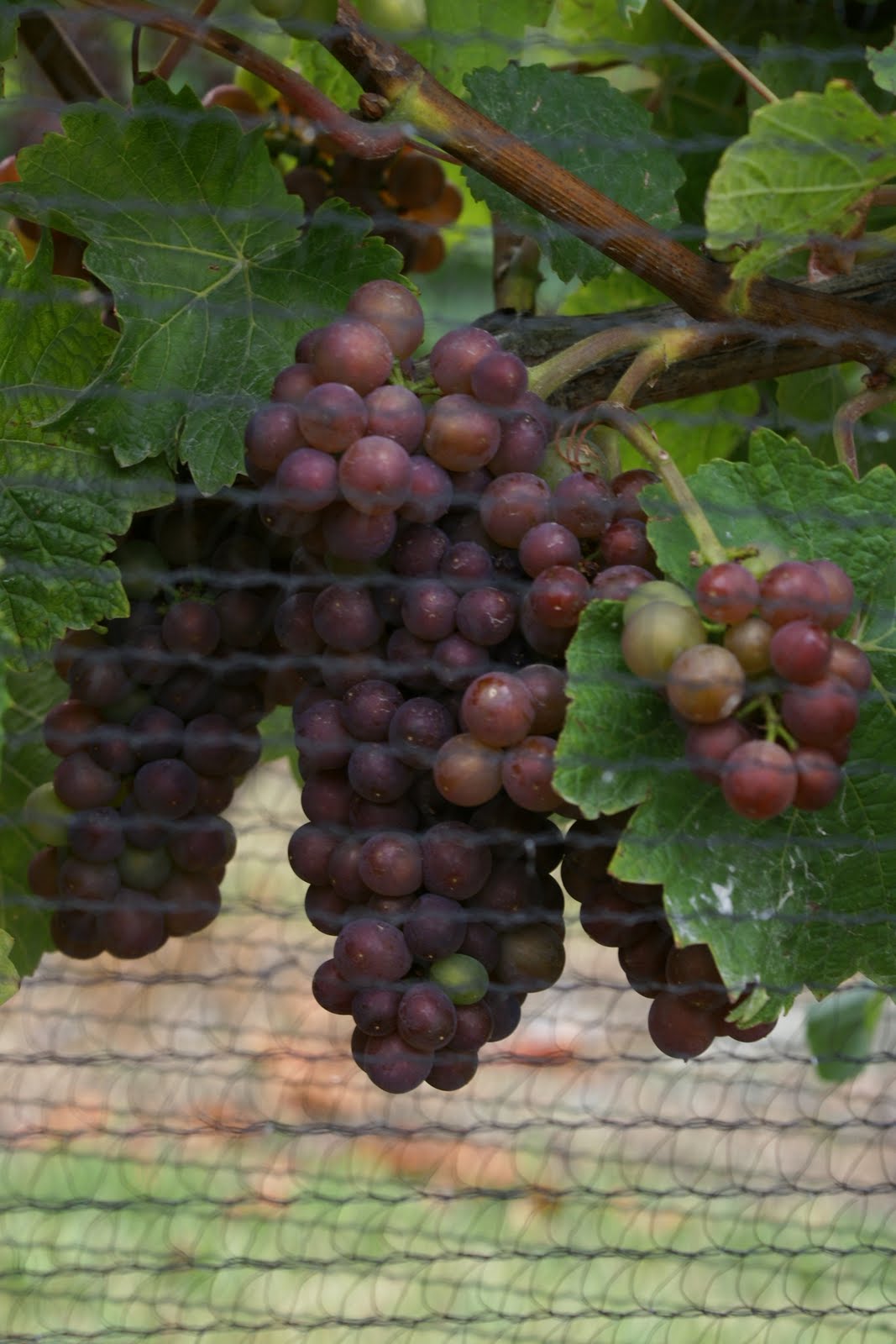
Went for a stroll in the vineyard to get over the stress (mine was not as bad as Winemaker Carl's though!), and cheered myself up when I saw how good the 2010 Pinot Gris, is looking -  as the image above shows. I often get asked about the differences between Pinot Gris and Pinot Noir, and the answer is not a lot. The name comes from the fact the berries are not as dark as Pinot Noir. They are grey in colour, not black and Gris is simply the French word for grey; as is Grigio in Italian. That said, the berries are quite dark this year, but we will separate the skins from the juice quite quickly so the wine will still be white.

You have all read my earlier grumbles about the cool weather slowing ripening in older posts. Well the last week has been great with a warm, dry start to autumn, which just as well as we are seeing colour changes in the poplars now. The grapes won't be far behind. Every warm day is a big plus. In the winery we are setting up the equipment ready to handle the harvest; destemmer, ferments, tanks, etc, so the excitement for crush 2010 is building!

Monday, May 4, 2009

Martinborough & Burgundy

Monday 4th May

Today dawned cloudy and cold. I think the ‘Indian Summer’ we have been enjoying has come to an end. As the grapes are all in, we can relax, particularly as the weather forecast for the rest of the week is rain, rain, rain……

All the work from now on is in the winery, nursing our precious ferments through to a good conclusion. A nervous time as we monitor each individual ferment carefully – it’s a bit like a nervous parent watching over a new-born child – only we have 30 of them! Even ‘Octamom’ cannot top that!

Tomorrow I’ll get Carl to explain what we are looking for with so many different ferments underway, but this evening I thought I’d talk about why Martinborough, of all New Zealand’s Pinot Regions, comes closest to the home of the world’s classic Pinot Noirs – Burgundy.

The geological character of the fabled Côte-d’Or is made up of three key elements – limestone, clay and sand. The varying percentages of these elements is what makes wines from each part of Burgundy so different to another - compare a delicate Volnay from the south to a powerful Chambertin from the north.

Like Burgundy, Martinborough is fortunate in that it is made up of a number of regions, each with differing soils, ranging from ancient gravels through to ancient marine deposits or clays. These wonderful soils are partnered with a climate that mirrors Burgundy – hot summers, mild autumns and cold winters. As a consequence the geological variations present us with a range of wines similar to Burgundy. looking at each map, one cannot fail to notice the similarities - both regions stretch north to south, yet are quite narrow. Both contain regions that produce fine Pinot Noir at the pinnacle of the very best, yet at the same time, also produce wines that are less complex, but represent great value for money.

The various sites can give us wines like those from Chambolle-Musigny (good colour and body, firm, yet with a distinctive suppleness) while others (like the Dry River region where Murdoch James is located) make wines more like a Clos de Vouget (deep red in colour, harmonious, elegant with a long finish). In other areas we see wines that are more solidly structured with rich aromas and long finishes, that some compare to a fine Corton.

Even if one disagrees with my examples it is harder to deny that of all New Zealand’s Pinot Noir regions, only Martinborough has such a variety of sites, all producing world-class Pinot Noir, in such a small area.

Tuesday, April 28, 2009

Pinot Gris and Pinot Noir

Tuesday 28th April

Well a few days have gone by and we are almost through harvest. Only the Cabernet Franc and the Syrah left to bring in now. We are still enjoying a marvellous run of fine weather, and the quality of fruit coming in remains high. All the Pinot Noir and Pinot Gris ferments are under way and looking good, and I’ll talk in future posts about how we manage the ferments for optimum quality. But today I thought I’d talk a little about these two varieties.

Pinot Noir is a red wine grape variety of the species Vitis vinifera. The name may also refer to wines produced predominantly from Pinot noir grapes. The name is derived from the French words for "pine" and "black" alluding to the varietals' tightly clustered dark purple pine cone-shaped bunches of fruit. Pinot Noir grapes are grown around the world, mostly in the cooler regions, but the grape is chiefly associated with the Burgundy region of France and, increasingly, New Zealand, where wines that match their Northern Hemisphere cousins are making their mark. Pinot Noir is widely considered to produce some of the finest wines in the world, but is a difficult variety to cultivate and transform into wine.

Pinot Gris is a white wine grape variety of the same species, Vitis vinifera. Thought to be a mutant clone of the Pinot Noir grape, it normally has a grayish-blue fruit, accounting for its name ("gris" meaning "grey" in French) but the grape can have a brownish pink to black and even white appearance. The wines produced from this grape also vary in color from a deep golden yellow to copper and even a light shade of pink. The clone of Pinot Gris grown in Italy is known as Pinot Grigio.


Interestingly, the DNA profiles of both Pinot Gris and Blanc are identical to Pinot Noir. Pinot Gris is a bud sport of Pinot noir, presumably representing a somatic mutation in either the VvMYBA1 or VvMYBA2 genes that control grape colour. Pinot Blanc may represent a further mutation of Pinot Gris. (Source: Wikipaedia)

Tuesday, April 14, 2009

Birth of a Wine


7th April 2009

I used to dream of owning my own vineyard while I sat in my Melbourne office surrounded by paperwork. I loved my job but always yearned for the chance to be involved in the magic process called winemaking. This yearning first started when I was at Auckland University and met Bruce Collard of Collard Wines, one of the first New Zealand wineries to focus on classic varietal wines. On occasions I would visit the winery with Bruce and developed a love for good wine; first as a consumer, but then I got thinking about actually making the this magic thing called wine!
Luckily I did not think about the hard work and costs to come! So, over the years while I was living in Australia I thought more and more about it until, with the encouragement of my wife Jill, we purchased our first vineyard in 1986. This was just a small 2 hectare block in the heart of Martinborough which has come to be regarded as the home of premium New Zealand Pinot Noir. From that humble beginning, we now have over 25 hectares of our own and several fantastic growers who supply us with great fruit. Our winery is located at our Blue Rock vineyard, which we purchased in September 1998. The winery is located in a stunning setting on the banks of the Dry River where we also have a café and our cellar door.
We are just about to start our 10th vintage and I started thinking about all the highs and lows of the last 10 years and felt it was a pity that we had not shared that with those who love our wines.
Hence this page on our website! We are going to start a diary of events at Murdoch James (www.murdochjames.co.nz) starting with the first pick of grapes for the 2009 Vintage. Log on from time to time and follow with us the joy (and sometimes the frustration) of owning a vineyard. We will post candid comments about events and our experiences as we wrestle with the challenges of making ever better wines year after year, in partnership with Mother Nature.
We are a small family owned that prides itself in making boutique wines that will appeal to wine lovers who have discerning tastes and a passion for the highest quality. In other words, these are not every-day high volume wine labels that would typically cater to the mass market.
Share Vintage 2009 and the rest of the year with us, and feel free to make contact and send encouragement or ask questions! We love to be in contact with folk who enjoy fine wine.
In vino veritas! Roger Fraser, co-owner, Murdoch James Estate