Showing posts with label Autumn. Show all posts

Friday, May 6, 2011

Lab Work

I sometimes think a lot of folk get the impression that wine is all about growing the grapes in the vineyard and then converting them to wine in the winery. That is true to a large extent, as is the reality that the making of a great wine comes down to the creative talents of the winemaker. There are no formulas to follow slavishly, unless you are one of the big producers who are looking for the same basic wine year after year.

But there are a lot of technical things small wineries can do to help ensure we make a good wine and avoid risks. At Murdoch James Estate we have a small laboratory where we test sample from the vineyard before harvest to check sugar levels, and during ferments to track the conversion of those sugars to alcohol. We also test for things like acidity. This technical detail is then paired with winemaker Carl's judgement and palate to deliver the final wine.


For the vintage Maria, our Administration Assistant, worked with Carl in the winery over vintage to help with processing, plunging and pressing. But she also did most of the lab work; a very important task she completed with skill.


This year's grapes are now in, and nearly all the ferments are complete. It has been a lovely harvest and the Pinot Noir should be excellent this year. Fine weather made harvest a breeze, and the teamwork was terrific. Now the vineyard looks a treat as the autumn colours are coming out. In fact, when I was driving into work this morning, the poplars at the gate were stunning and I had to take a photo - not a bad place to work is it!!??
                                                        

Saturday, March 13, 2010

A Split Personality! Pinot Gris, Pinot Noir and My Social Media Journey

I am developing a split personality. I am not quite sure where this blog is heading. It started out as a way to track our wines through the year after harvest, but it seems more of a Social Media commentary each time I post to it!

Each day I am amazed how much there is to learn about social media and story-telling, and the communication vehicles that are available. Today I just watched the launch video for Google Wave, and the technological advances were mind-boggling. How I put that together with my small steps in Twitter and Facebook I'm not sure yet. What I do know is that all this stuff is converging , and it will get easier day-by-day for the user to communicate with people interested in their products (in our case, wines obviously). I am also learning that there are good and bad ways to use these tools. I guess the single most important learning is that one cannot use these media to 'push' your product at people. There is no better way to turn them off. But, if you can share valuable and credible information with the internet community, the folk who like what they see will contact you. People often say that social media takes too much time. My view is that the the 'time' bit is correct, but not the 'too' bit! Who would not want to talk directly with their customers? There is no doubt we are getting tour booking and winery sales from these initiatives. Not a lot, but growing slowly. Just as important are the on-line relationships I now have with wine lovers all around the world. We share information about our wines, other wines, images, experiences and our locations. It brings us closer together in a relationship that certainly has a commercial element to it, but in which the commercial side follows on from a meaningful and more comprehensive relationship based on information exchanges.

On the wine side, we had a bit of a bad week last week when we had a blend of Pinot Noir all ready for bottling and the labels were a 'no-show'. Luckily we found out about that before we had pumped the wine (13,000 litres!) into the tanker for transport down to the bottling plant. So, just put a layer of protective argon on top of the wine in tank until the labels turn up. Argon is a gas that sits on top of the wine, and does not dissolve in it. The gas forms a protective layer between the wine and the air. Still a bummer to lose the bottling date. Now we need to wait until another one is available; hopefully not too long as we have export customers waiting for the wine
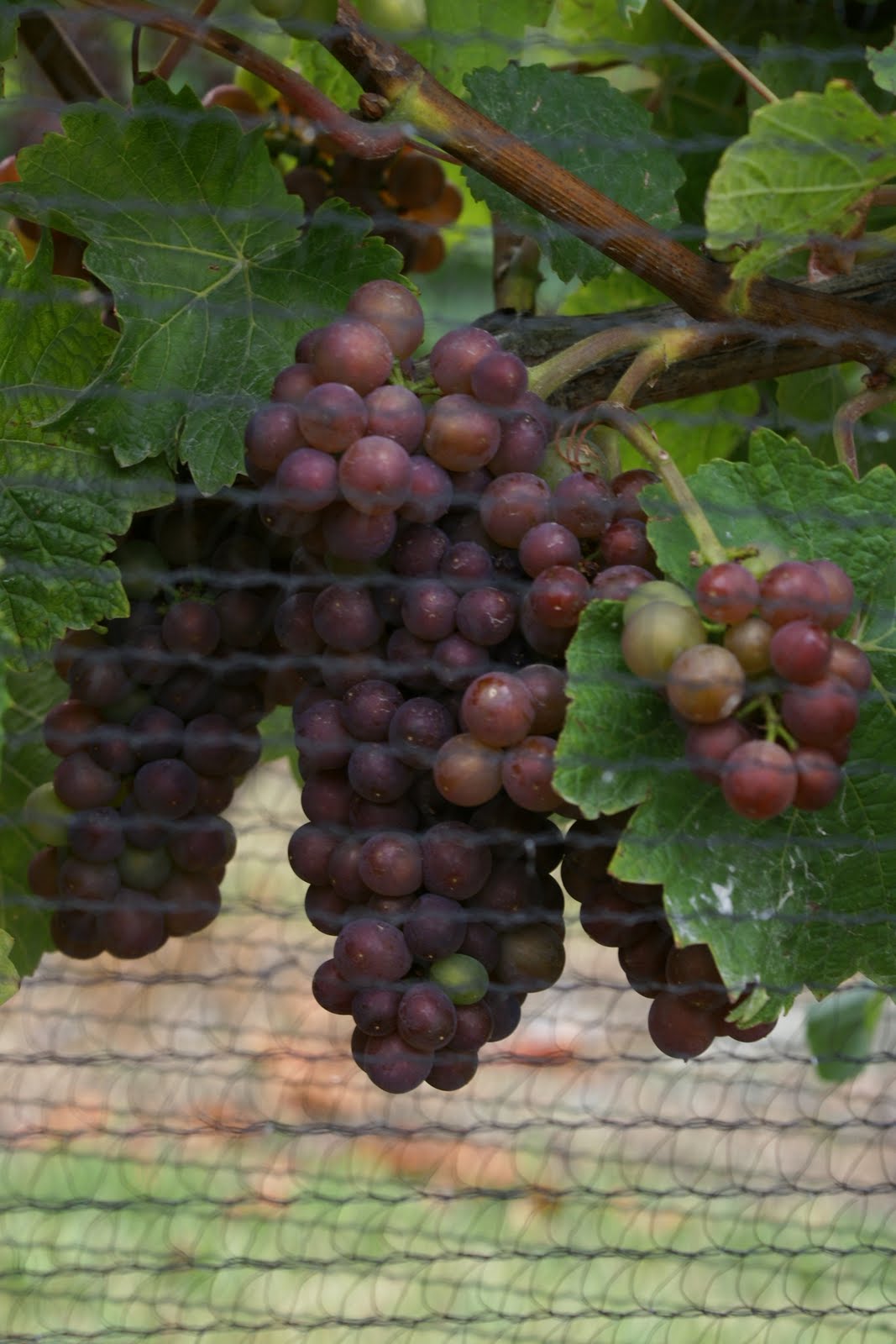
Went for a stroll in the vineyard to get over the stress (mine was not as bad as Winemaker Carl's though!), and cheered myself up when I saw how good the 2010 Pinot Gris, is looking -  as the image above shows. I often get asked about the differences between Pinot Gris and Pinot Noir, and the answer is not a lot. The name comes from the fact the berries are not as dark as Pinot Noir. They are grey in colour, not black and Gris is simply the French word for grey; as is Grigio in Italian. That said, the berries are quite dark this year, but we will separate the skins from the juice quite quickly so the wine will still be white.

You have all read my earlier grumbles about the cool weather slowing ripening in older posts. Well the last week has been great with a warm, dry start to autumn, which just as well as we are seeing colour changes in the poplars now. The grapes won't be far behind. Every warm day is a big plus. In the winery we are setting up the equipment ready to handle the harvest; destemmer, ferments, tanks, etc, so the excitement for crush 2010 is building!

Monday, April 20, 2009

Vineyard Soil Profiles


Monday 20th April

Well a rainy day today at last, not heavy, but drizzly. It is forecast to pass quite quickly, then we are back into fine, dry conditions again. The drive into the vineyard is looking beautiful in full autumn colour now. As not a lot is happening with the harvest, I thought it would be good to talk a bit about our soils at our vineyard.

It has often been said that the soils and climate of Martinborough are very similar to that of the world’s greatest Pinot Noir vineyards; being the plantings of the Côte d’Or, in Burgundy. While it is true the climate is similar, the soils in most of Martinborough have much more in common with the gravely soils of Bordeaux, than the Côte d’Or.

10 kilometres south of Martinborough, in the Dry River region, it is a different story. Murdoch James Estate’s “Blue Rock” vineyard exhibits characters much closer to Burgundy. While retaining the low rainfall necessary to grow premium grapes, the soils here are quite different to the rest of Martinborough. On close scrutiny, the soil at “Blue Rock” has much more in common with those at Domaine Romanee Conti, Richbourg, and La Tache. They are free draining, limestone-based soils that give an added element of opulent richness and ‘flesh’ to the wines made from grapes grown on them.

For those interested in more detail, at Blue Rock the various blocks have slightly different characteristics. The Blue rock vineyard sits on five river terraces, four of which are elevated. All the elevated ones are predominately north facing. However there are subtle and interesting differences in the soil structure of each block.

1. Lower Flats Block: 1 ha, located on an old riverbed with very shallow loam soils over gravel beds.

2. Nelson Block: Lower First Terrace, 6.6ha - Sloping to the north, with moderate silt loam soils over gravels

3. Pipers Block: Back First Terrace, 2.85ha - Sloping to the northeast with moderate silt loam soils over gravels

3. Jims Block: Second Terrace, 3.07ha - Sloping north with deep silt loam soils over very deep gravels

4. Highfold: Third Terrace, 6.33ha - Sloping direct north contour, with deep silt loam soils with very deep gravels, and a high lime content.

Other observations:
• All soil pits dug on the property show deep silts with high mineral and lime content over varied gravel depths.
• Past profile holes have shown grape vine roots penetrating over 3 meters down.
• At this depth, they are still approximately 5mm thick.
• Machinery use is restricted in winter to avoid soil compaction.
• Summer irrigation is used on the sloping blocks